- The largest melatonin dose-response meta-analysis (26 RCTs, 1,689 people) confirmed that sleep onset and total sleep time plateau between 1mg and 3mg.
- While 3mg produces strong sedation in lab settings, it frequently triggers vivid dreams, midnight awakenings, and next-morning grogginess.
- 1mg delivers ~85% of peak sleep onset speed without dream disturbances or morning hangover.
- When paired with evening blue light blocking glasses, a 1mg dose is the true sweet spot: the glasses protect your natural melatonin production, while 1mg provides the precise circadian signal to initiate deep sleep.
You're Probably Taking the Wrong Dose
Walk into any pharmacy and you'll see melatonin in doses from 1mg to 10mg. The internet says "take 0.3mg, that's the physiological dose." Your doctor says "try 3mg." Your friend swears by 10mg gummies.
Who's right?
In 2024, a team of researchers from the University of Pisa and the University of Surrey published the largest and most rigorous melatonin dose-response study ever conducted. They analyzed 26 randomized controlled trials spanning 1987 to 2020, with 1,689 total participants, and mapped exactly how melatonin's effects change with dose and timing.
The findings completely reframed how we understand melatonin dosing — and why neither the 0.3mg micro-dose nor the 5-10mg mega-dose makes sense in the real world.
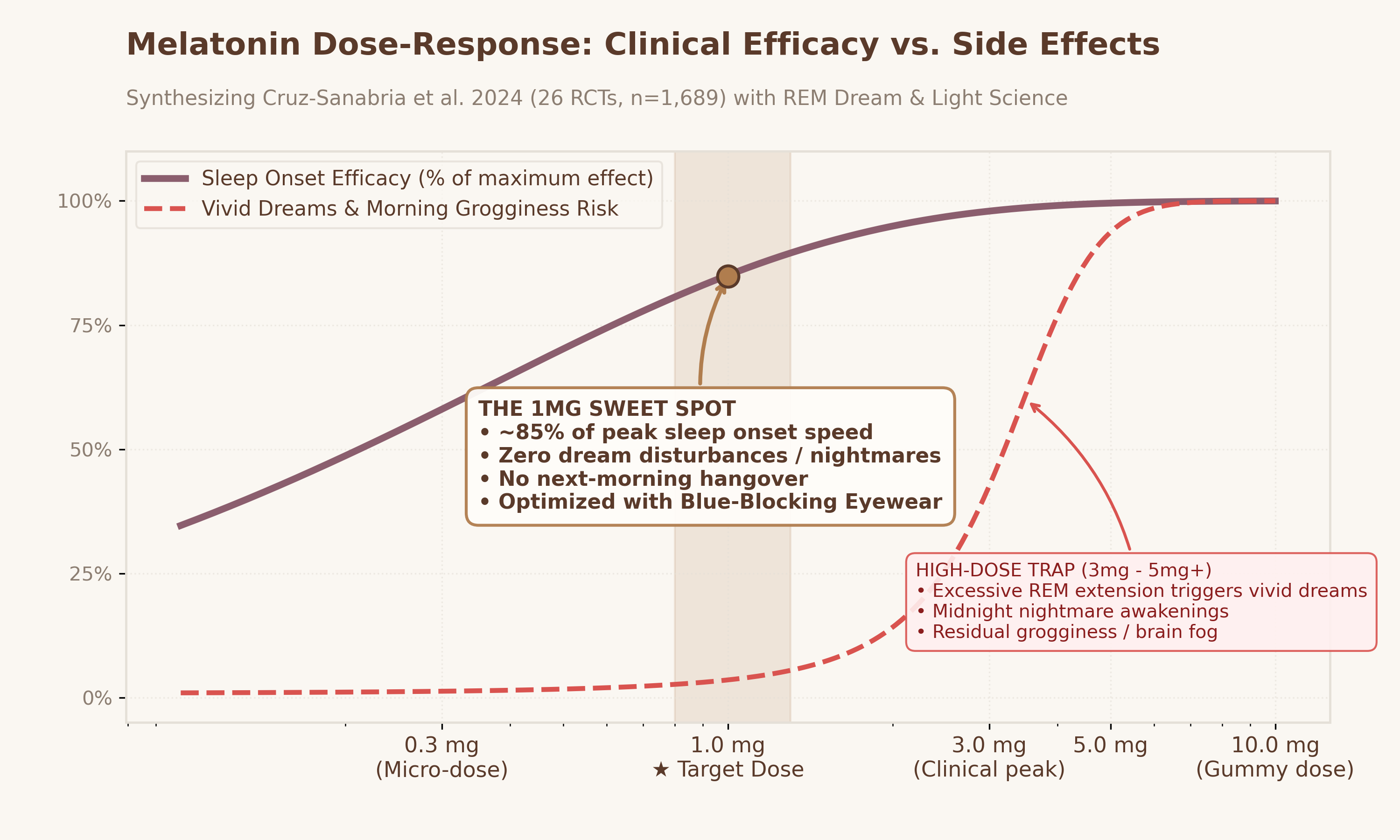
The Clinical Dose-Response Curve
Cruz-Sanabria et al., 2024 — Journal of Pineal Research
Published in one of the world's leading circadian rhythm journals, this meta-analysis pooled data from double-blind, placebo-controlled trials across both insomnia patients and healthy adults. It is the only study that systematically mapped the dose-response curve for sleep onset latency and total sleep duration.
Key findings:
1. Melatonin has a real dose-response curve. Up to a point, higher doses reduce the time it takes to fall asleep.
2. Total sleep time plateaus early. Sleep duration reaches its maximum around 3mg. Above 3mg, you experience flat diminishing returns — you do not gain additional sleep by taking 5mg or 10mg.
3. The steepest efficacy gains occur between 0.3mg and 1mg. By 1mg, you have already captured roughly 85% of the total sleep onset benefit observed at 3mg.
4. Timing matters more than brute dose. Taking melatonin 2 to 3 hours before your target bedtime is significantly more effective than taking it 30 minutes before sleep.
The High-Dose Problem: Vivid Dreams & Morning Hangovers
If 3mg maxes out sleep time in a sterile lab trial, why do so many people feel terrible taking 3mg or 5mg at home?
The answer comes down to two major drawbacks of higher doses: REM sleep extension and plasma clearance half-life.
1. Intense, Vivid Dreams and Midnight Awakenings
Melatonin is not a sedative; it is a chronobiotic hormone that influences sleep architecture. Specifically, higher doses of melatonin extend the duration of REM (rapid eye movement) sleep — the phase of sleep where dreaming occurs.
At doses of 3mg to 5mg+, excessive REM stimulation frequently causes:
- Intensely vivid, hyper-realistic, or bizarre dreams
- Midnight nightmare awakenings (often coinciding with the 2 AM–4 AM cortisol surge)
- Restless, fractured sleep despite being technically unconscious
If your goal is to stay asleep through the night and avoid waking up in a panic, a heavy 3mg to 5mg melatonin dose can actually backfire.
2. The Next-Morning "Melatonin Hangover"
Your body clears melatonin through hepatic (liver) CYP1A2 metabolism. When you take a physiological dose (1mg or less), circulating levels decline naturally before morning alarm time.
When you take 3mg, 5mg, or 10mg, blood plasma levels remain elevated well past dawn. Melatonin continues binding to MT1 and MT2 receptors in the brain when you should be waking up, causing that heavy, sluggish "brain fog" and morning grogginess.
Why 1mg Is the True Sweet Spot
When evaluating the full picture — sleep onset speed, sleep continuity, dream stability, and morning clarity — 1mg emerges as the optimal dose.
At 1mg:
- Fast Sleep Initiation: You achieve approximately 85% of the sleep latency reduction seen at higher doses.
- Zero Dream Disruption: REM sleep architecture remains balanced and natural, eliminating the vivid nightmares common at 3mg+.
- Clean Morning Wake-Up: The hormone clears from your bloodstream by morning, leaving zero lingering grogginess.
- Natural Receptor Sensitivity: It avoids flooding and desensitizing your brain's MT1 and MT2 receptors.

The Missing Link: Coupling 1mg With Evening Light Hygiene
Why did researchers historically believe people needed larger doses in the first place? Because of screen light.
A landmark 2015 PNAS study demonstrated that evening screen exposure (phones, tablets, e-readers) suppresses your body's natural melatonin synthesis by over 50% and delays circadian melatonin onset by 1.5 hours. A 2023 Nature Communications Biology study confirmed this dose-dependent light suppression in real-world lighting environments.
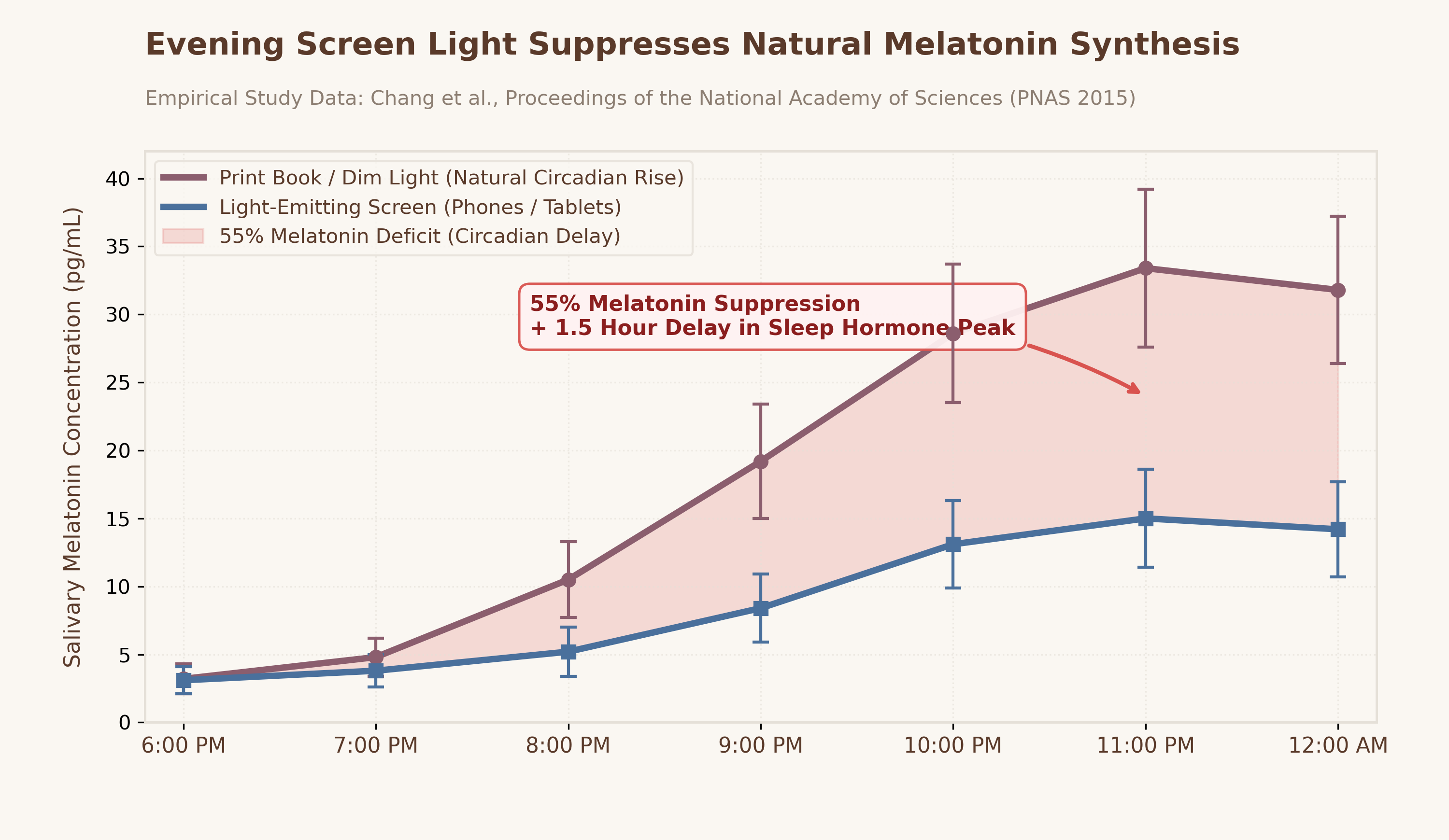
When 460–480nm blue light strikes the photoreceptive ganglion cells in your eyes, your brain receives an immediate signal that it is noon daylight. Taking a heavy 3mg or 5mg melatonin pill is effectively a pharmacological sledgehammer trying to brute-force sleep against an awake signal.
The mechanical solution is far more elegant: block the blue light at the source so your body can produce its own melatonin naturally.

The Smarter Strategy: Fix the Light, Lower the Dose
Rather than taking an excessive dose of melatonin to compensate for screen light, the far more effective protocol is to protect your natural melatonin at the source:
1. Wear Clinical Blue Light Blocking Glasses: Put on specialized amber/orange eyewear 2 to 3 hours before bed. Unlike cheap clear "computer glasses" (which only filter 10–20% of blue light), clinical C2 amber lenses block ≥98% of the specific 460–480nm wavelength that shuts off melatonin synthesis.
2. Take 1mg of Melatonin: Because your natural melatonin is no longer being destroyed by screens, your body does not need a massive dose. A clean 1mg provides the exact nudge required to initiate smooth sleep onset.
3. Combine With Restorative Nutrients: Pair 1mg melatonin with calming nervous system minerals like Magnesium Taurate or Bisglycinate, the restorative amino acid L-Theanine, and botanical GABA support. The 1mg melatonin sets the circadian clock, while the synergistic minerals and amino acids keep your body physically relaxed and asleep.

> ✦ Protect Your Natural Melatonin:
> If you watch TV, read on a tablet, or check your phone in the evening, our Seluna Evening Blue Light Blocking Glasses feature clinical-grade C2 amber lenses (≥98% block at 460–480nm) designed specifically to preserve your circadian rhythm and eliminate nighttime eye strain. Now open for pre-order.
The Dose Cheat Sheet
| Dose | Biological Impact | Dream & Morning Side Effects | Best Application |
|---|---|---|---|
| 0.3mg | Subtle physiological replacement | None | Jet lag phase-shifting in pitch-dark environments |
| 1.0mg | ~85% of peak sleep onset speed | Zero dream disruptions, zero morning fog | The Goldilocks sweet spot (especially with blue-blocking eyewear) |
| 3.0mg | Peak total sleep time in lab settings | High rate of vivid dreams, occasional grogginess | Short-term acute sleep onset difficulty |
| 5.0mg+ | Plateaued benefit, receptor saturation | Frequent nightmares, morning hangover | Not recommended for daily sleep |
The Bottom Line
The science is clear: mega-dosing melatonin is counterproductive, while 0.3mg micro-doses are often underpowered against modern indoor lighting.
By pairing 1mg of melatonin with evening blue-blocking eyewear, you get the best of both worlds: rapid sleep onset, stable and dream-peaceful nights, and a clean, energized wake-up with zero hangover.
FAQ
Why do so many commercial supplements contain 5mg or 10mg?
Marketing, not biology. In the supplement aisle, consumers often assume "more is better." Because melatonin is inexpensive to manufacture, brands compete by inflating dosages, even though clinical trials show total sleep time plateaus at 3mg and side effects skyrocket.
Will 1mg melatonin cause strange or vivid dreams?
No. At 1mg, melatonin supports natural sleep cycling without triggering the hyper-extended REM episodes that cause chaotic dreams and midnight nightmare awakenings at 3mg to 5mg.
When is the best time to take 1mg melatonin?
Take it 2 to 3 hours before your desired bedtime, right around the time you dim overhead lights or put on blue-blocking glasses. This mirrors your body's natural dim-light melatonin onset (DLMO).
Can I take 1mg melatonin every night?
1mg is considered exceptionally gentle and well-tolerated. For optimal results, combine it with foundational light hygiene, restorative minerals like magnesium, and calming amino acids like L-theanine rather than relying on melatonin alone.
This article is for educational purposes only and is not medical advice. Talk to your doctor before starting or changing any supplement regimen.
Want more sleep science? Join our weekly newsletter at seluna.works — research-backed sleep education, zero spam.